


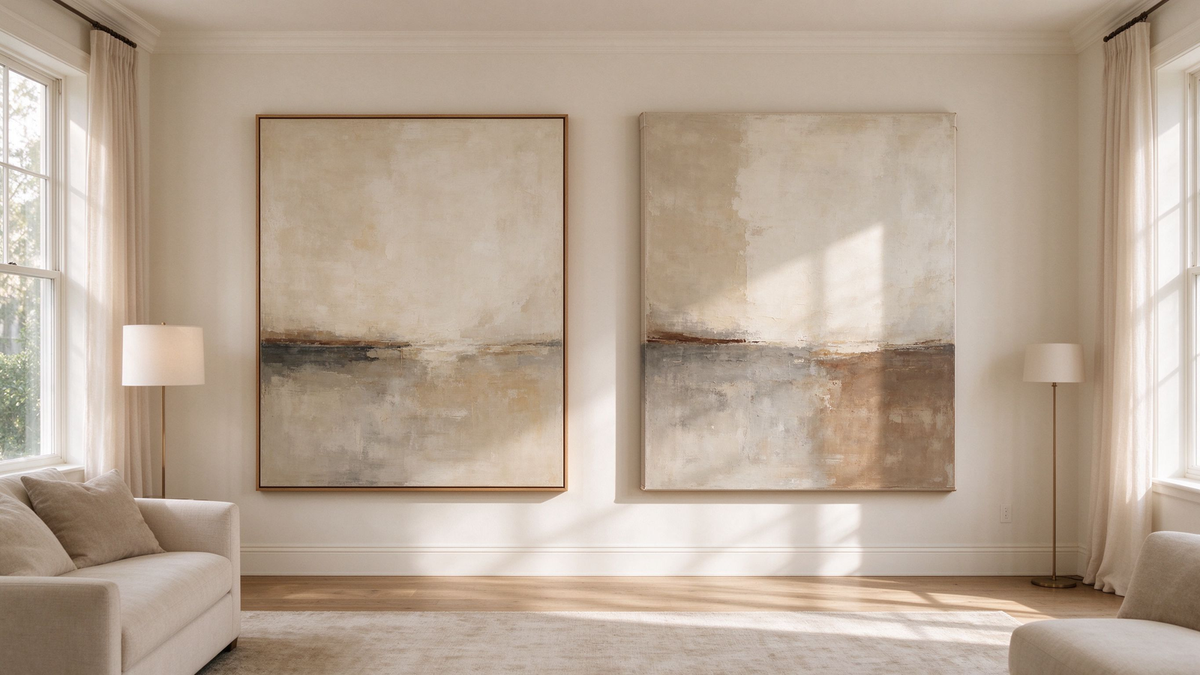
When you fall in love with a hand-painted abstract canvas, the last thing you want is to get the finishing wrong. Yet "framed" and "gallery wrapped" are two finishing styles people use interchangeably — and they change the entire feel of the piece, not to mention how it sits in your room.
At Welstell, every painting starts as an original work on canvas, and the finishing style you choose becomes part of the artwork. This guide compares framed and gallery wrapped canvases across the details that actually matter: appearance, depth, durability, cost, and how each works in different rooms.
What Does "Gallery Wrapped" Mean?
A gallery wrapped canvas is stretched over a wooden frame so the canvas wraps around the sides and is secured on the back. The front is the artwork itself, and the sides are either left clean white, painted to match, or covered with an extension of the painting.
Because there is no external frame, the image continues to the very edge of the canvas. This gives a clean, contemporary, "art gallery" look that works beautifully with large abstract pieces.
Key features:
- No outer frame — the canvas IS the finished edge
- Usually 1.5 to 2 inches deep (deep-edge, or "museum" style)
- Modern, minimal, and great for large statement art
- Side edges can be painted, wrapped, or left white
What Does "Framed Canvas" Mean?
A framed canvas sits inside an outer moulding — typically wood or metal — that surrounds the artwork. The frame provides a defined border and a traditional, finished look. Frames range from slim minimalist profiles to ornate classic mouldings.
Key features:
- An outer frame surrounds the canvas
- Adds a visual boundary that anchors the piece
- Comes in countless profiles, colours, and materials
- Classic, versatile, and easy to coordinate with furniture
Gallery Wrapped vs. Framed: The Key Differences
| Factor | Gallery Wrapped | Framed Canvas |
|---|---|---|
| Look | Modern, gallery-like, seamless | Traditional, defined, polished |
| Edge finish | Canvas wraps around sides | Canvas hidden inside a frame |
| Depth | Typically 1.5–2 inches deep | Depth varies with moulding |
| Best for | Large abstracts, modern & minimal homes | Classic interiors, detailed scenes, small pieces |
| Durability | Very durable, no frame to damage | Frame protects edges |
| Cost | Usually lower (no frame) | Adds framing cost |
| Wall weight | Lighter | Heavier |
When to Choose Gallery Wrapped
Choose gallery wrapped when you want the artwork to feel like a modern gallery piece — especially if the art is large, abstract, or the centerpiece of a room. Because the canvas edges are finished, you can hang it without a frame, keeping the focus on the painting itself.
- Modern and minimal interiors: Clean edges suit Scandinavian, Japandi, and contemporary styles.
- Large statement pieces: Oversized abstracts look airy and striking without a heavy frame.
- Cost-conscious projects: You skip the frame entirely, so a gallery wrapped canvas is often the more affordable high-impact choice.
- Matching colors on edges: With a gallery wrapped canvas you can extend the palette onto the sides, making the piece blend beautifully with your wall.
When to Choose a Framed Canvas
Choose a framed canvas when you want a finished, decorative border that ties the artwork to your furniture and trim. Frames add warmth and structure, which suits traditional, transitional, and farmhouse-style rooms.
- Classic and traditional interiors: A wood or gold moulding instantly reads as "collected art."
- Small to medium pieces: Frames give smaller paintings presence and importance.
- Detailed or figurative art: A frame separates the busy detail from the surrounding wall.
- Coordinating with decor: Match a frame to your table wood, floor tones, or picture rail.
Practical Considerations
Lighting and reflection: Framed canvases with glass (though less common for canvas) can glare; a frame without glass keeps the texture visible. Gallery wrapped canvases show the natural paint texture beautifully under any light.
Dust and cleaning: Both are low-maintenance. Framed edges collect dust along the moulding; gallery wrapped edges can be gently wiped.
Rehanging flexibility: A gallery wrapped canvas can be re-stretched or hung unframed. A framed canvas is locked into its moulding unless you reframe it.
Shipping and handling: Gallery wrapped canvases are lighter and easier to handle. Frames add weight and fragility in transit.
The Welstell Take
Our hand-painted abstracts are designed to work both ways. Most of our collectors start with a gallery wrapped finish to keep the contemporary look pure, then add a slim frame later if their room changes. Because each Welstell painting is an original, the finishing choice should support — never fight — the artwork.
Still undecided? Picture the room, not just the canvas. Modern, large, minimal → gallery wrapped. Classic, detailed, coordinated → framed. And if you're still torn, a slim black or natural wood frame over a gallery wrapped canvas gives you the best of both.
Ready to Find Your Canvas?
Browse the Welstell collection of hand-painted abstract wall art and choose the finish that fits your home. Looking for a custom size or specific palette? Explore our custom oil paintings service. Every piece is an original, made to last, and shipped ready to hang.
Share:
Japandi & Wabi-Sabi Wall Art: How to Choose Minimalist Neutral Paintings for Your Home
How to Hang Large Canvas Art Like a Pro: Height, Spacing, and Hardware Rules