


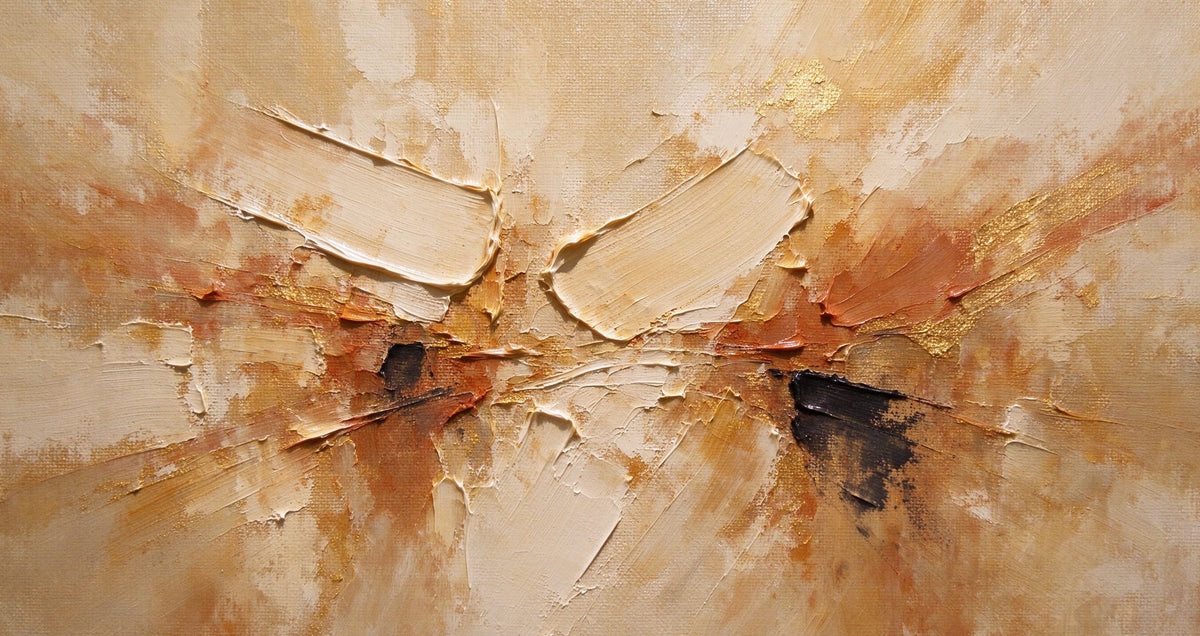
Look closely at a truly hand-painted painting and you'll notice something a print can never fake: the surface is alive. Paint sits in thick, raised ridges. Brush and palette-knife marks catch the light. From across the room it reads as color — up close, it reads as sculpture.
This is impasto, and it's the reason textured canvas art has become one of the most sought-after looks in modern interiors. In this guide, we'll explain what impasto art is, why textured paintings feel so different from flat ones, and how to choose the right textured piece for your home.
What Is Impasto Art?
Impasto is a painting technique in which paint is applied so thickly that it stands up from the canvas in visible ridges. The word comes from the Italian impastare — "to make into paste" — and the technique has been used by artists for centuries to add weight, drama, and physical presence to their work.
Impasto is usually applied with a palette knife or a loaded brush, leaving bold, three-dimensional marks. Instead of a smooth, flat surface, the painting has real topography: peaks and valleys of pigment that change with the light and with the angle you view them from.
Impasto vs. Flat Canvas: What's the Difference?
| Feature | Impasto / Textured Painting | Flat Canvas Art |
|---|---|---|
| Surface thickness | Paint raised in thick ridges and peaks | Smooth, thin, even surface |
| Light and shadow | Catches and casts shadow as light moves | Largely static under light |
| Touch | Visible and tangible brush / knife marks | Flat to the touch |
| Viewing distance | Works at a distance and up close | Best viewed from a distance |
| How it's made | Hand-applied, layer by layer | Thin painting or printed reproduction |
| Uniqueness | Every ridge is unique — cannot be printed | Can be reproduced in copies |
Why Textured Art Is Dominating Modern Interiors
1. It Plays With Light
A textured painting is a living surface. Morning light skims across the ridges, evening light deepens the shadows. The piece looks different at different hours — something a flat print, however beautiful, never does.
2. It Adds Depth to Minimalist Rooms
Modern and minimalist interiors strip away pattern and ornament. Texture is how these rooms keep from feeling cold: one sculptural painting gives a neutral wall the warmth and interest that rugs and accessories once provided.
3. It's a Sensory Counter to a Digital World
We spend our days looking at flat screens. A piece of art you can almost feel — with visible paint and real depth — brings a tactile, human quality back into the home. It's handmade, physical, and unmistakably real.
4. It Can't Be Faked by a Printer
You can print a photograph of impasto, but you can't print the relief. A true textured painting is inherently one of a kind. If you want art that no factory can copy, impasto is the answer.
Why Oil Is the Perfect Medium for Impasto
Not every paint can hold the thickness impasto demands. Oil paint is naturally dense and dries slowly, which lets the artist build layer after layer and shape the surface while it's still workable. That's why most serious impasto work — including Welstell's textured paintings — is done in oil.
Oil also ages beautifully. Properly cared for, a thick oil painting keeps its ridges and its color for decades — the sculptural surface is archival, not a trend.
How to Choose Textured Canvas Art for Your Home
- Texture intensity: from subtle knife strokes to dramatic peaks. Match the drama to your room — bolder texture suits open spaces, quieter texture suits bedrooms and reading corners.
- Palette: choose colors that echo your room's existing tones. Warm neutrals and earthy accents are the easiest to live with; deep, rich colors make a stronger statement — our abstract wall art collection shows bold palettes in action.
- Scale: textured paintings reward size — a larger piece gives the relief room to read. Follow the sizing rules for your wall and furniture.
- Light: place the painting where light hits it from the side rather than straight on. Side light is what makes the ridges come alive.
- Framing: gallery-wrapped canvas (edges painted, no frame) lets the texture feel continuous; a simple frame suits softer textures.
How to Care for Textured Paintings
- Dust gently with a soft, dry brush or microfiber cloth — never wipe the surface with pressure.
- Keep textured art out of direct, prolonged sunlight to protect the oil surface and colors.
- Avoid humid areas like bathrooms; stable indoor conditions are all a well-made oil painting needs.
Frequently Asked Questions
Is impasto art the same as 3D art?
Not exactly. Impasto refers to the thick application of paint that creates a three-dimensional surface. "3D art" is a broader term — impasto is the most common way hand-painted canvas art achieves a 3D effect.
Can a textured painting be printed?
No. A print can reproduce the look of texture on a flat surface, but the actual raised relief — and the way it moves with light — can only be created by hand.
Do textured oil paintings need special care?
Very little. Dust gently with a soft brush, avoid harsh sunlight, and keep the painting in stable indoor conditions.
Is impasto a modern technique?
No — it's centuries old, used by painters for generations. What's new is how popular textured art has become in contemporary interior design.
Bring Real Texture to Your Walls
Flat prints decorate. Textured paintings transform — they give a room a surface you can see change with the light, and an honesty that can't be reproduced.
Explore Welstell's textured wall art collection, or browse hand-painted oil paintings and let the texture do the talking.
Share:
The Ultimate Wall Art Size Guide: How to Pick the Perfect Canvas for Your Living Room & Sofa
Japandi & Wabi-Sabi Wall Art: How to Choose Minimalist Neutral Paintings for Your Home