


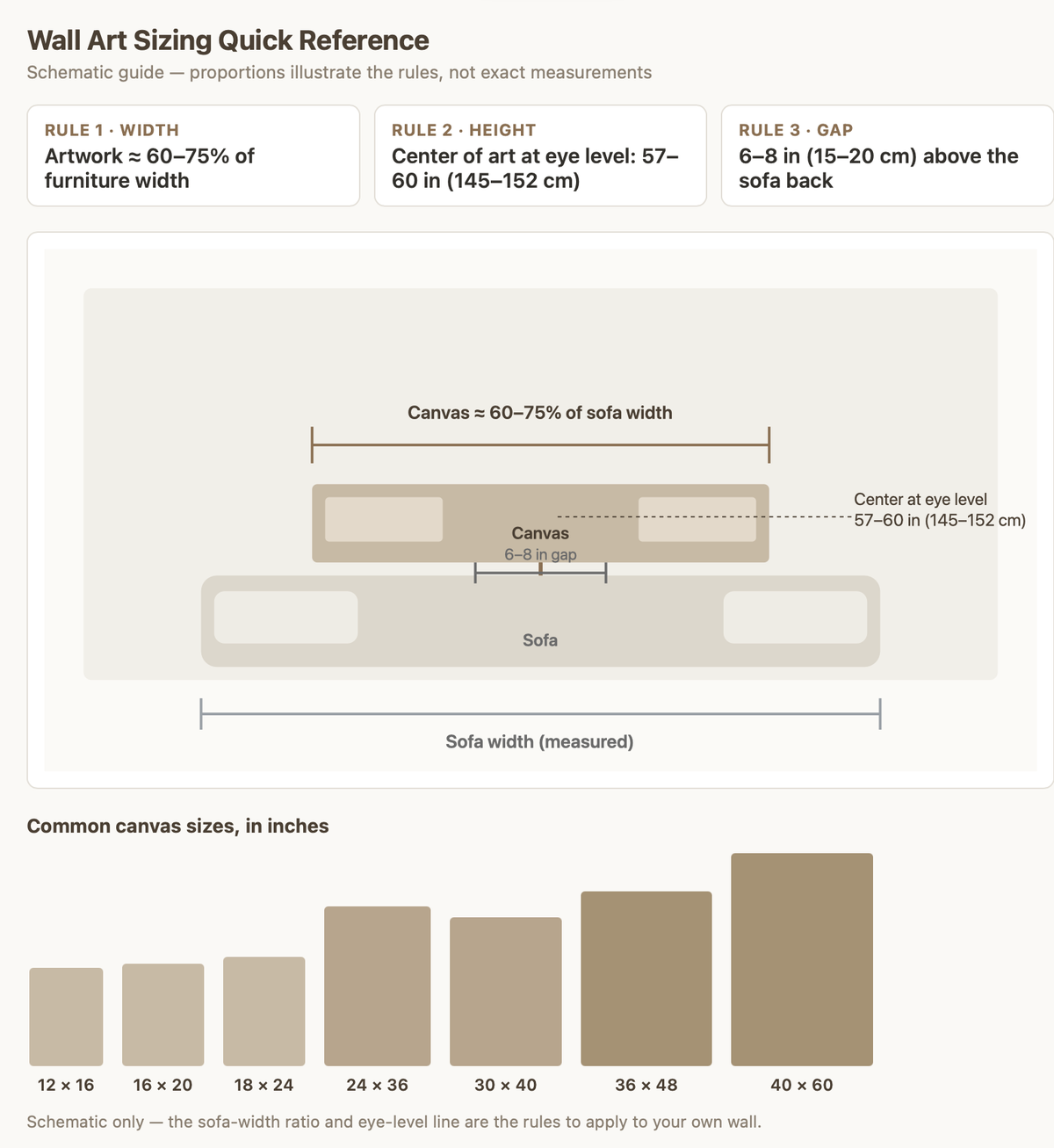
Most living rooms don't have a wall-art problem — they have a size problem. Artwork that's too small gets lost against the sofa, floats awkwardly in the middle of the wall, and makes even a beautiful painting look like an afterthought.
The fix isn't more expensive art. It's the right size. In this guide, we'll walk you through the golden rules of wall art sizing and show you exactly what works above your sofa — the only measurement you need is one quick look at your furniture.
The Three Golden Rules of Wall Art Sizing
Before any style talk, get these three rules right. They solve 90% of sizing mistakes.
Rule 1: The 60–75% Width Rule
The artwork — or the arrangement of artworks, treated as one unit — should cover roughly 60–75% of the width of the furniture beneath it. A 3-seater sofa that's 84 inches wide pairs best with a canvas around 50–56 inches wide. A console at 48 inches wants art around 30–36 inches wide.
For a bare wall with no furniture below, let the art fill about two-thirds of the wall's usable width, with breathing room on both sides.
Rule 2: Eye-Level Hanging
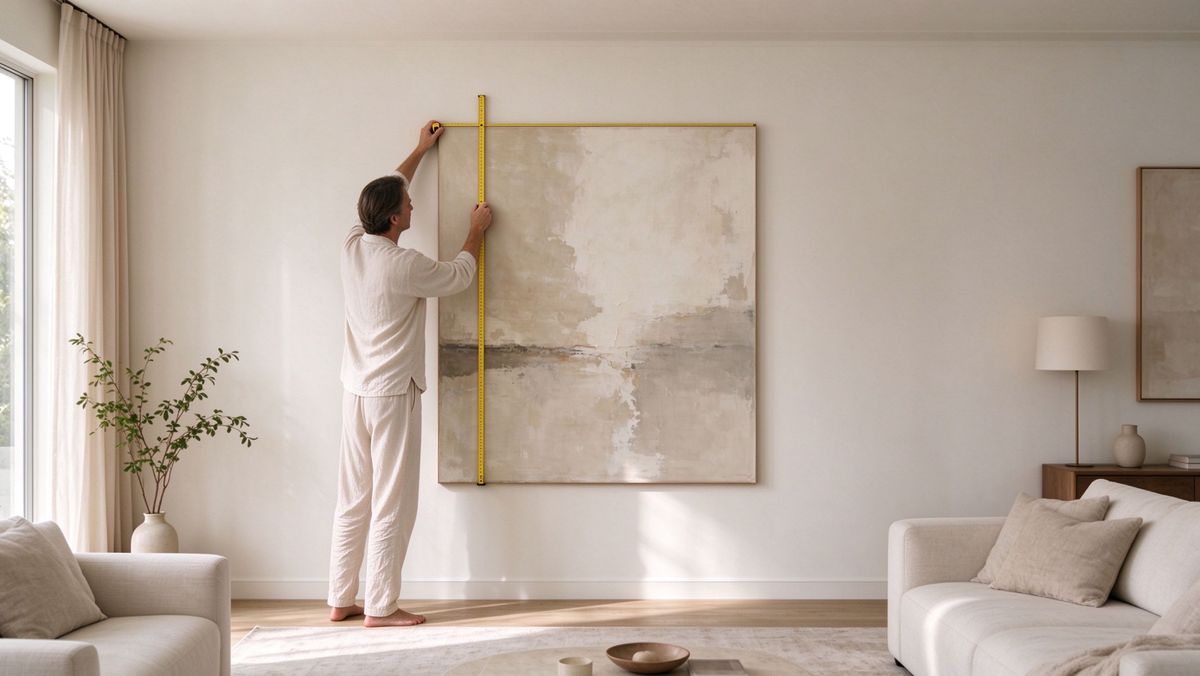
The center of the artwork should sit at eye level: about 57–60 inches (145–152 cm) from the floor. This is the height art galleries use — it's simply the most comfortable height to view art while standing.
Rule 3: Give It Air Above the Sofa
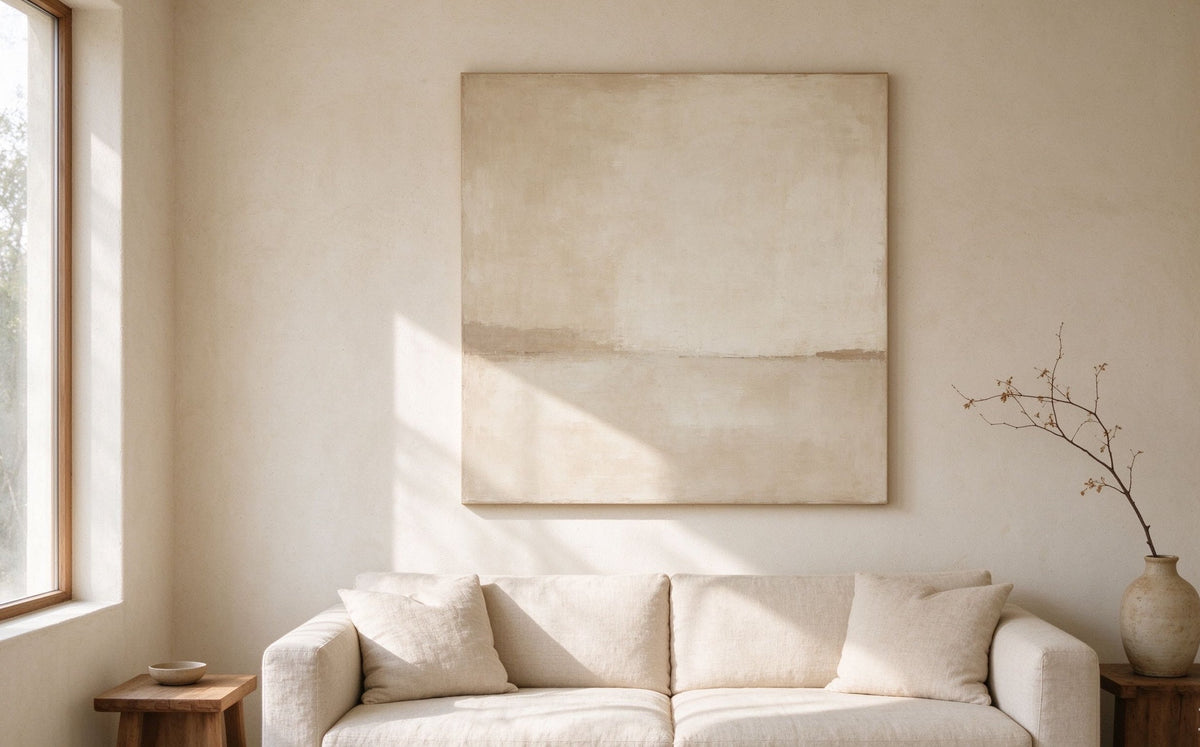
When hanging above a sofa, leave 6–8 inches (15–20 cm) between the top of the sofa back and the bottom of the frame. Too high and the art disconnects from the sofa; too low and it feels crowded.
Quick math: measure your sofa width, multiply by 0.6–0.75 — that's your target artwork width. Then hang the center at 57–60 inches from the floor, and keep 6–8 inches above the sofa back.
Above the Sofa — The Most Important Wall in the Room
The sofa wall is where sizing mistakes are most visible, so start here.
- 3-seater sofa (about 78–90 in wide): one canvas around 50–60 in wide — or a set of three panels that together span the same width.
- 2-seater sofa (about 60–72 in wide): one canvas around 36–48 in wide.
- Loveseat or compact sofa: one canvas around 30–40 in wide.
When in doubt between two sizes, go larger. A slightly generous canvas reads intentional; a slightly small one reads accidental.
Standard Canvas Sizes and Where They Work Best
| Canvas size (in) | Best for | Placement notes |
|---|---|---|
| 12 × 16 | Entryways, above nightstands, small nooks | Pair in groups of 2–3 |
| 16 × 20 | Small walls, office corners | Works alone or in a grid |
| 18 × 24 | Hallways, reading corners, above a desk | Versatile all-rounder |
| 24 × 36 | Above a 2-seater sofa, dining room | One strong focal piece |
| 30 × 40 | Above a 3-seater sofa, fireplace mantel | The classic living-room size |
| 36 × 48 | Large sofas, open walls | Statement scale |
| 40 × 60 | Oversized sofas, high ceilings | Fills a big wall with one piece |
| 48 × 72+ | Two-story walls, large open rooms | Bold, gallery-scale |

One Large Canvas or a Gallery Wall?
One large canvas is the easiest way to make a living room feel curated: it creates a single focal point and suits modern, minimalist, and Japandi interiors. If your sofa wall is 60–75% covered by a single statement painting, you're done. Looking for that one statement piece? Browse our abstract wall art for canvases made to anchor a room.
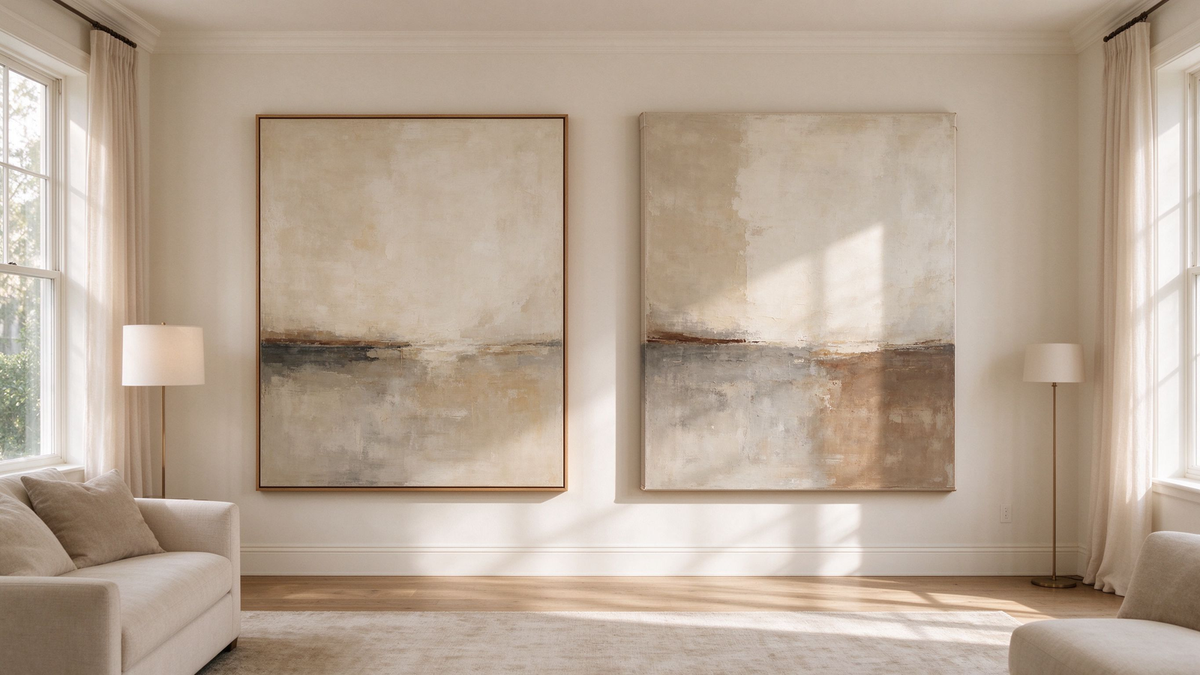
Choose a gallery wall when your wall is unusually wide or irregular, or when you want to display a personal collection. The secret: treat the whole arrangement as one piece of art. Plan the total footprint to follow the 60–75% rule, keep 2–3 inches between frames, and lay it out on paper (or the floor) before hammering a single nail.
Special Situations: High Ceilings, Narrow Walls, and More
- High ceiling or two-story wall: don't hang the art up to the ceiling. Keep the center at eye level and choose an oversized piece (40 × 60 or larger) that fills the space without climbing the wall. Tall vertical canvases also work beautifully here.
- Narrow wall (36–48 in wide): go vertical — 20 × 40, 24 × 48, or a tall triptych. Horizontal art will feel squished.
- Above a console or sideboard: aim for about two-thirds of the furniture width, and allow 4–6 inches between the art and the piece below.
- Behind a sofa with floor lamps or plants: keep the arrangement centered on the sofa, not on the wall — the eye follows the furniture.
Can't Find Your Size? Go Custom
Here's the advantage of hand-painted art: you're not limited to standard sizes. Welstell paints custom oil paintings made to your exact wall dimensions, so the piece fits your sofa wall like it was designed for it — because it was.
Frequently Asked Questions
What size canvas should I use above a 3-seater sofa?
Aim for a canvas (or a grouping) that covers 60–75% of the sofa width — typically 50–60 inches wide for a standard 3-seater.
How high should I hang art above the sofa?
Hang the center at 57–60 inches from the floor and leave 6–8 inches between the sofa back and the bottom of the frame.
What size art works on a small wall?
Match the art to the wall: a narrow wall calls for vertical pieces (20 × 40 or 24 × 48); a small wall next to a window can take a single 16 × 20 or 18 × 24.
Can Welstell paint art in a custom size?
Yes — every Welstell piece is painted by hand, and custom sizes are made to your wall's exact measurements.
Measure Once, Hang It Right
Size is the cheapest upgrade in decorating — choosing correctly costs nothing. Measure your sofa, apply the 60–75% rule, keep the center at eye level, and let the art do the rest.
Ready to find your perfect fit? Browse Welstell's living-room wall art collection, or commission a custom piece in the exact size your wall needs.
Share:
Original Oil Painting vs. Canvas Print: 5 Key Differences You Need to Know Before Buying
What is Impasto & Textured Canvas Art? Why 3D Art Is Dominating Modern Interior Design