


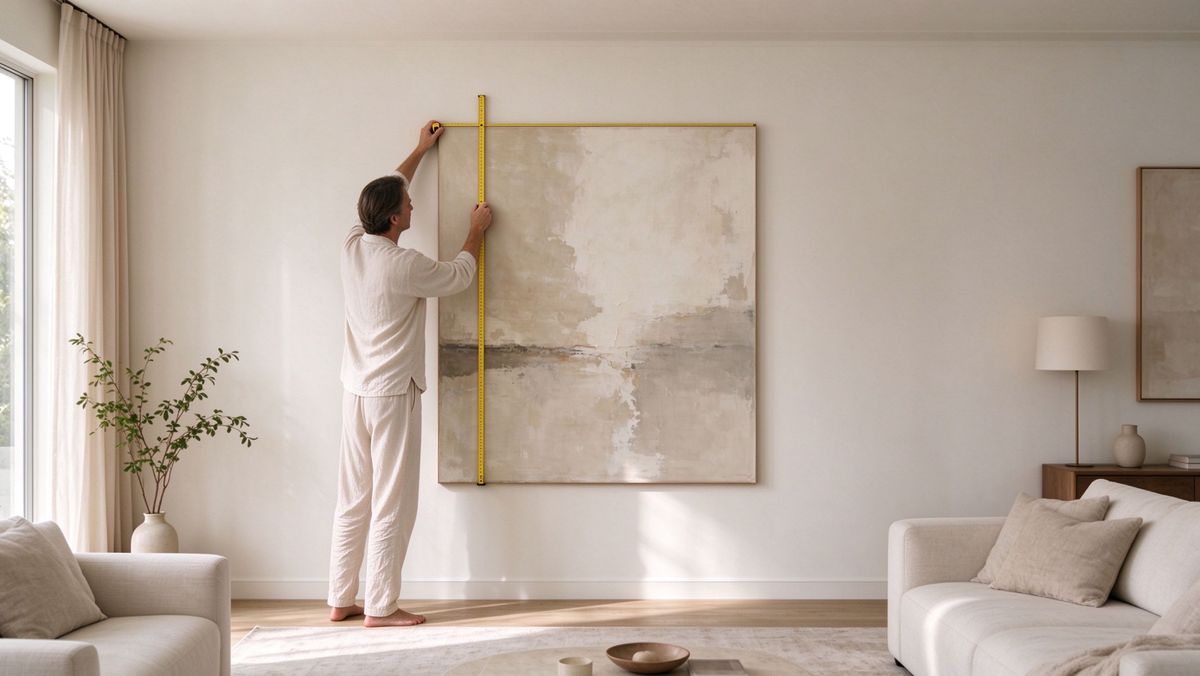
A large canvas can transform a bare wall into the heart of a room — but only if it hangs right. Too high and it floats. Too low and it feels cramped. Crooked, and every guest notices.
The good news: professional hangings follow simple, repeatable rules that anyone can use. This guide gives you the exact height, spacing, and hardware approach Welstell recommends for large and oversized hand-painted canvases, so your new piece looks gallery-perfect from day one.
The Golden Rule: Eye Level at 57–60 Inches
Interior designers and galleries almost always hang art so the center of the artwork sits at 57 to 60 inches from the floor. This is the average human eye level, and it makes art feel naturally integrated with the space.
For most rooms this means:
- Measure the height of your canvas.
- Divide by two to find the midpoint.
- Add 57–60 inches to find where the midpoint should sit.
- That tells you where the top (and the hanging hardware) should go.
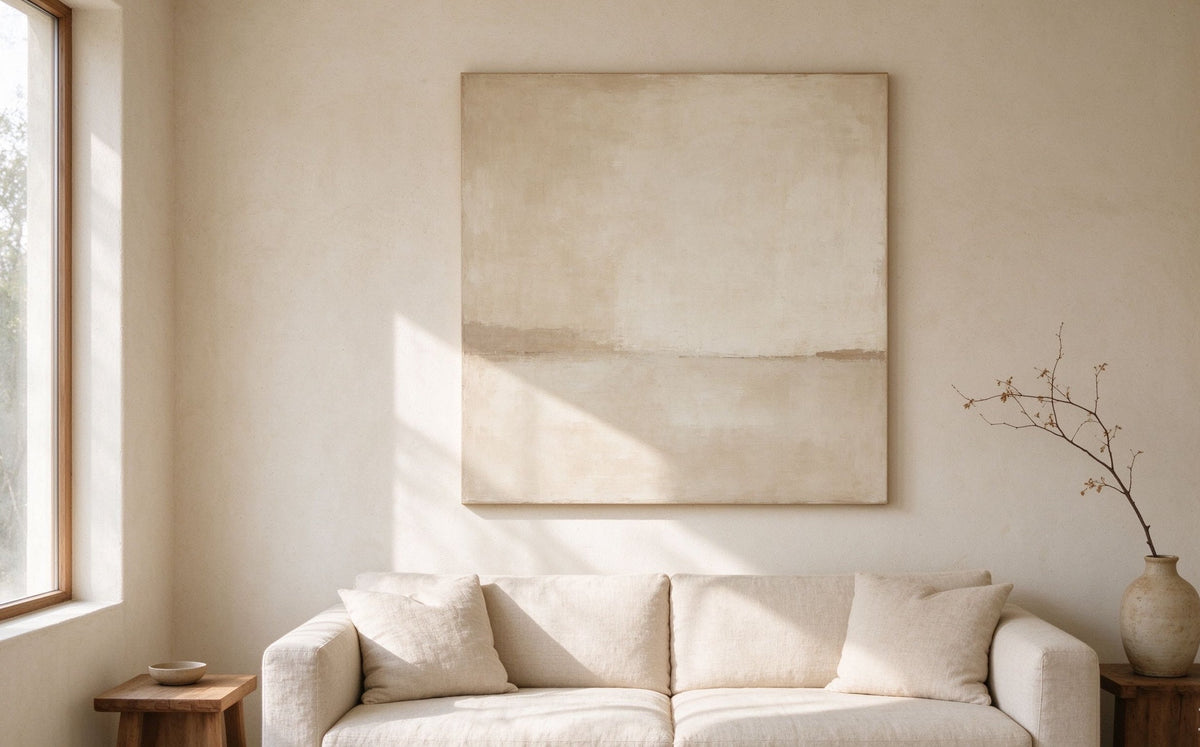
Exception — above furniture: If your canvas hangs above a sofa, console, or bed, the bottom of the frame should sit 6–10 inches above the top of the furniture, and the whole grouping should feel connected to the piece beneath it.
Above a Sofa or Bed: The 6–10 Inch Rule
Large canvases often live above seating. Keep these measurements in mind:
- Bottom of the art: 6–10 inches above the back of the sofa or headboard.
- Width: The artwork (or art grouping) should be about two-thirds to three-quarters the width of the furniture below it. (Need help sizing? Check out our wall art size guide).
- Centering: Center the canvas over the furniture, not the wall.
A canvas that is too wide overwhelms the sofa; one that is too narrow looks lost. The two-thirds-to-three-quarters guideline keeps the balance right.
Hanging Two or More Large Canvases: Spacing Rules
Planning a pair, a triptych, or a gallery wall of large pieces?
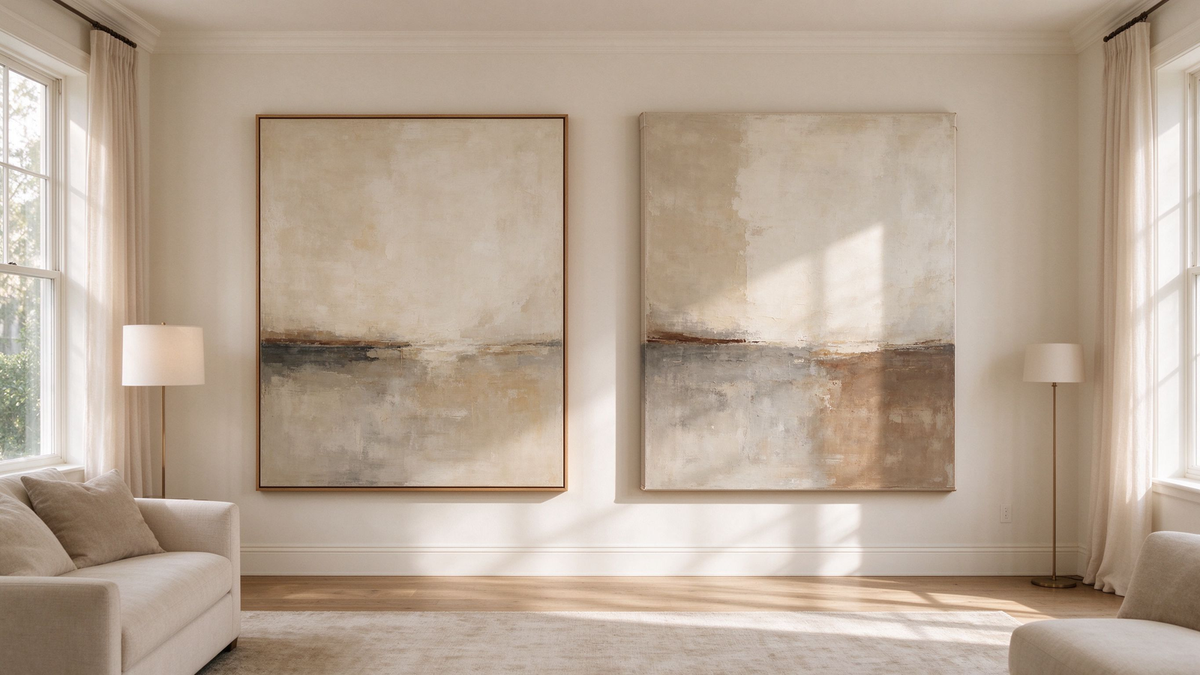
- Even spacing: Keep 3–5 inches between canvases of the same series. For very large pieces, 4–6 inches keeps them breathing.
- One center line: Treat the whole group as one composition. Align the centers or the bottom edges — pick one and stay consistent.
- Equal weight: Balance visual weight so no single piece dominates.
- Test first: Lay the canvases on the floor against the wall to plan the layout before driving any nails.
Choosing the Right Hardware
Large canvases are heavy, so hardware matters more than aesthetics. Use hardware rated for at least the full weight of your piece.
| Canvas weight | Recommended hardware |
|---|---|
| Up to 10 lb (4.5 kg) | Two heavy-duty picture hooks or D-rings |
| 10–30 lb (4.5–14 kg) | Two D-rings + wall anchors or toggle bolts |
| 30+ lb (14+ kg) | Two robust hanging wires on D-rings, or French cleats |
D-rings are your best friend: Most professional framers install two D-rings about one-third down from the top. This distributes weight and keeps the canvas level.
French cleats for very heavy pieces: For oversized canvases, a French cleat (a two-piece bracket) distributes weight across the full top edge and is far more secure than a wire.
How to Find the Stud (or Anchor When You Can't)
Whenever possible, drive your hardware into a wall stud. Use a stud finder and mark both studs if the canvas is wide. No stud where you need it? Use wall anchors (toggle bolts or heavy-duty drywall anchors) rated for the canvas weight. Never rely on a single small nail for a large piece.
A Step-by-Step Hang in 5 Minutes
- Mark eye level: Measure 57–60 inches up and mark the wall.
- Find the midpoint: Measure your canvas height, divide by two, and mark the center point on the canvas.
- Line them up: Align the canvas center with your wall mark, then trace where the top edge lands.
- Locate studs: Mark stud positions with a stud finder.
- Install hardware: Screw the D-rings/wire or cleat into the frame, then the wall side into studs/anchors.
- Hang and level: Hang the canvas, then adjust with a spirit level.
Pro Tips for a Flawless Result
- Use two people for large canvases: Protect both the art and the wall.
- Keep a level handy: Even a half-degree tilt is visible on a large piece.
- Step back and photograph it: A phone photo makes tilt and spacing issues obvious.
- Recheck after a week: Large canvases settle; a quick re-level keeps them perfect.
Your Large Canvas Is Ready to Hang
Every Welstell hand-painted canvas ships with sturdy hanging hardware, ready to install. Now that you know the rules, you can hang it with confidence — and it will look professionally installed in minutes.
Share:
Framed vs. Gallery Wrapped Canvas: Which Finishing Style Suits Your Home Best?